
Time management and productivity
Time management and productivity training for teams
- Tailored after a scoping call
- In person or remote
- For whole teams
- Habits, not another app
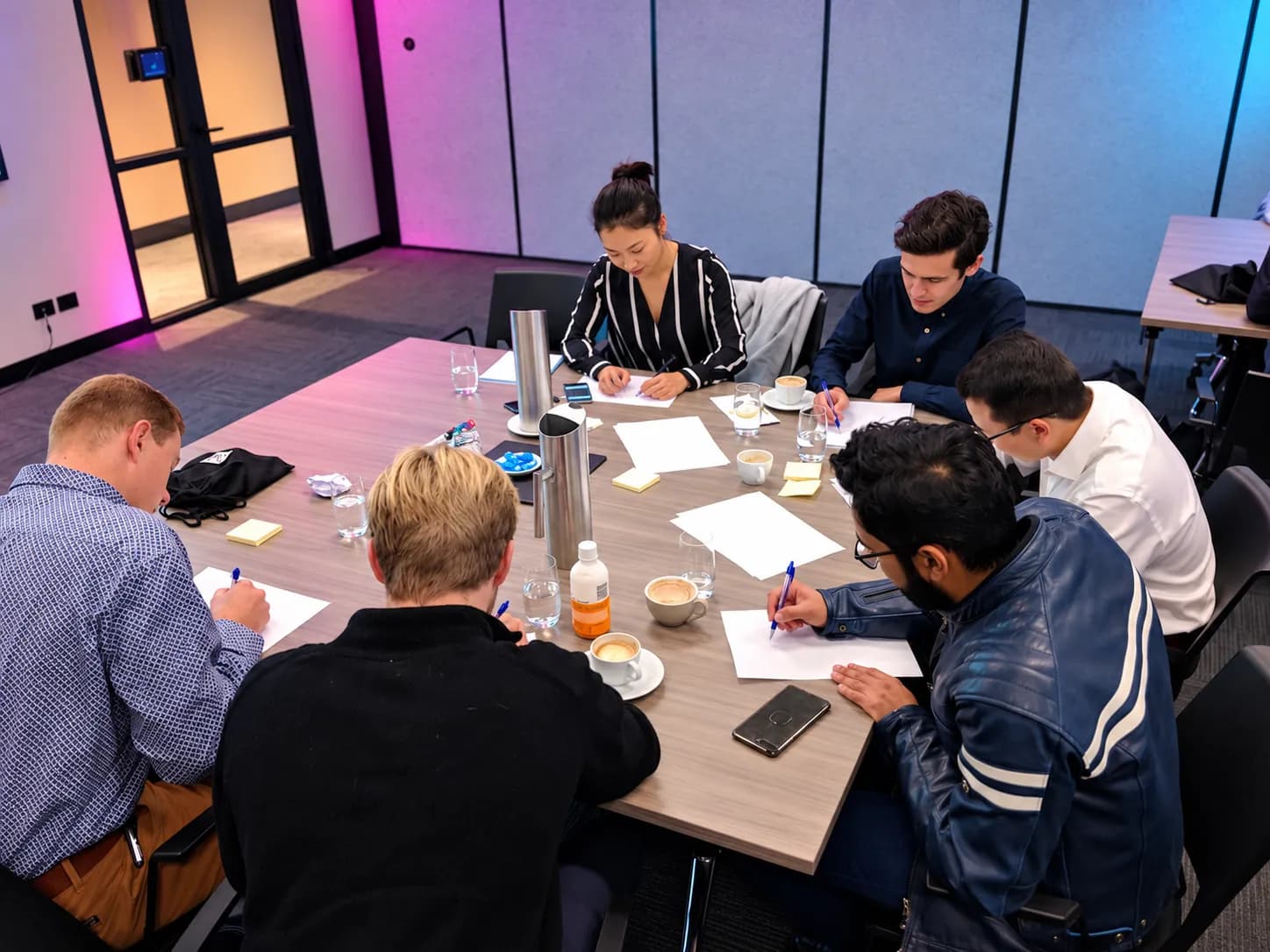
Most time management training is aimed at individuals: better to-do lists, cleverer calendar tricks, inbox zero. Those tips help a little, but they rarely survive contact with the real problem. In most organisations, people do not lose their time alone. They lose it together, in meetings that should have been messages, in constant interruptions, in unclear priorities, in approvals that bounce back and forth and in an always-on culture that nobody chose. Individual tips cannot fix team habits.
Collective Campus runs time management and productivity training for teams across Australia that works at both levels. Individuals learn to plan, prioritise and protect focus. Teams learn to change the shared habits that steal everyone's time: meetings, messaging, handoffs and the expectation of instant replies. The approach draws on the ideas in *Time Rich*, the book on doing less and achieving more written by Collective Campus founder Steve Glaveski, and on the capability building work Collective Campus has done with teams since 2015.
Quick answer
Time management training for teams helps people and teams spend more of their time on the work that matters. Good programs audit where time actually goes, clarify priorities, cut low-value work, redesign meetings and messaging habits, protect focus time, use tools including AI to remove busywork, and agree team norms that make these changes stick. The emphasis is on shared habits, not just personal tips. Collective Campus tailors every program after a scoping call, with no fixed format, length or group size, and does not publish prices.
Why time management is a team problem
Ask people why they cannot get their important work done and the answers are remarkably consistent: too many meetings, too many messages, unclear priorities, constant interruptions and work that keeps changing. Almost none of these are personal failings. They are the result of team habits and organisational systems.
- Meetings are scheduled by others, run long, lack clear purpose and multiply.
- Messaging tools create an expectation of instant response, fragmenting attention throughout the day.
- Priorities shift without anything being taken off the list, so everything becomes urgent.
- Handoffs and approvals create waiting time, rework and chasing.
- Always-on expectations push work into evenings and weekends.
A person who masters personal time management but works in a team with none of these problems solved will still struggle. That is why Collective Campus trains teams together, so the habits change for everyone at once.
Signs a team needs time management training
- Calendars are packed wall to wall, and real work happens before nine or after five.
- People say they are busy all the time but struggle to name what they achieved this week.
- Meetings regularly run over, finish without decisions or include people who did not need to be there.
- Messages and notifications interrupt work every few minutes.
- Deadlines are routinely missed or met only through heroic effort.
- Important but not urgent work, such as improvement, planning and development, never happens.
- People send emails late at night and feel they must reply to others' late messages.
- Burnout, stress leave or turnover is rising.
What the training covers
Each program is designed around the team's real calendar, workload and tools. These are the building blocks Collective Campus draws on.
1. A time audit
Teams start by looking at where their time actually goes, rather than where they think it goes. Individuals review their calendars and tasks over a recent period, and the team looks at patterns: how much time goes to meetings, messaging, focused work, rework and waiting. The results are usually surprising and create genuine motivation to change.
2. Clarifying what matters
Productivity is not doing more things. It is doing more of the right things. Teams clarify their most important outcomes and the work that really drives them, and individuals connect their own priorities to those outcomes. This makes it far easier to say no, or not now, to everything else.
3. Prioritisation that works
Participants learn and practise practical prioritisation methods: separating urgent from important, identifying the few tasks that produce most of the value and making explicit trade-offs when new work arrives. Teams agree how they will handle new requests so priorities are not silently overloaded.
4. Doing less: cutting low-value work
Much of what fills a working week adds little value: reports nobody reads, approvals that add no insight, status meetings that repeat what is already known. Teams identify work to stop, simplify or automate. Removing work is often the fastest productivity gain available.
5. Meetings that earn their place
Meetings are one of the biggest drains on team time. Teams review their recurring meetings and decide which to keep, shorten, combine or cancel. They agree simple rules: every meeting has a purpose, an owner and an outcome; the smallest group needed attends; updates move to written channels; and decisions are recorded.
6. Messaging and email habits
Teams agree how they use email, chat and phone: which channel for which purpose, what counts as urgent, what response times are reasonable and when notifications should be off. These agreements reduce interruptions dramatically.
7. Protecting focus
Deep, focused work produces most of the value in knowledge work, and it is the first casualty of a fragmented day. Individuals learn to block focus time and defend it, and teams agree shared focus periods with no meetings or non-urgent messages.
8. Planning the week and the day
Participants build a simple planning routine: a weekly review to set priorities and a short daily plan that allocates time to the most important work first. The routine is light enough to keep going when life gets busy.
9. Managing energy, not just time
Time is fixed, but energy varies. Participants learn to match demanding tasks to their peak energy, take real breaks and avoid the false economy of working longer hours. Sustainable pace is a productivity strategy, not a luxury.
10. Using AI and automation to remove busywork
AI tools can summarise long threads, draft first versions, prepare agendas and minutes, and handle routine admin. Participants learn practical ways to use approved tools to free time for higher-value work, and to avoid the trap of using AI to produce more low-value output. Teams that want deeper AI capability can explore Collective Campus AI training.
11. Delegation and handoffs
Leaders and senior staff often hold onto work that others could do. Participants practise delegating clearly and teams streamline handoffs so work waits less and moves faster.
12. Team agreements that stick
The program ends with a short team agreement covering meetings, messaging, focus time and response expectations, plus a rhythm for reviewing it. Without an agreement, habits drift back. With one, the team holds itself to the new way of working.
The meeting reset
Meetings deserve special attention because they are where team time is most visibly lost and most easily recovered. A meeting reset is a structured review of a team's recurring meetings. For each meeting, the team asks:
- What is this meeting for, and is that purpose still needed?
- Could the purpose be achieved asynchronously, through a written update or shared document?
- Who genuinely needs to be there? Who could receive notes instead?
- Could it be shorter or less frequent?
- Does it end with decisions and actions?
Teams commonly find they can remove or shrink a significant share of their recurring meetings without losing anything they value. The freed time goes back into focused work.
An always-on culture and the right to disconnect
Many Australian employees now have a legal right to disconnect, which gives them the right to refuse unreasonable contact outside working hours. Beyond the legal obligation, an always-on culture damages focus, wellbeing and the quality of work. High job demands and poor work design are also recognised psychosocial hazards that employers must manage.
Time management training helps teams move beyond compliance to genuinely sustainable habits: clear expectations about after-hours contact, scheduled sending of messages, agreed definitions of urgent and leaders who model healthy boundaries. These changes make teams both more productive and more sustainable.
Productivity, psychological safety and performance
Some of the biggest productivity problems are cultural. People attend meetings they do not need because declining feels risky. They accept unrealistic deadlines because pushing back feels unsafe. They reply instantly because silence might be read as slacking. Teams with higher psychological safety find it easier to question low-value work and agree healthier habits. That is why productivity training often connects with Collective Campus work on psychological safety and high-performance teams.
A hypothetical example of a team productivity reset
The following is illustrative only.
A project team feels permanently overloaded. The time audit shows that most of each person's week goes to meetings and messaging, and that the team's most important work, a major client deliverable, happens in fragments late in the day. In the training, the team cancels two recurring status meetings and replaces them with a short written update, agrees two mornings a week as shared focus time with no meetings, defines what counts as urgent and moves non-urgent questions to a single team channel checked at set times. Leaders agree to schedule after-hours emails rather than send them. The team reviews its agreement after a few weeks, keeps what worked and adjusts what did not.
Case studies from Collective Campus
Stuart. Stuart, Europe's leading on-demand logistics platform, asked Collective Campus to help optimise individual and team productivity, and mental health, as it expanded rapidly across Europe. Steve Glaveski, author of Time Rich, developed a four part webinar series covering the psychology of flow, personal productivity, team and organisation productivity, and mental health at work. The series received a 94% recommendation rating from participants.
ON Running. As ON Running grew, it turned to Collective Campus to design and deliver a productivity and workflow optimisation workshop to improve time and capital efficiency while keeping its fast-moving startup culture. The workshop covered team, manager and individual contributor productivity, including tools and techniques, and leaders left with actionable takeaways to pass on to their teams.
Charter Hall. Charter Hall wanted its people to create more valuable outcomes in less time, without investing in additional resources. Collective Campus developed a productivity session based on Steve Glaveski's Harvard Business Review article "The Case for the Six-Hour Workday", showing participants the ways they unwittingly sabotage their productivity and the tools and techniques that help. Participants spoke highly of the session, and Charter Hall became interested in rolling it out across more leadership groups.
Productivity for leaders
Leaders shape team productivity more than anyone. Their calendars become their teams' calendars, their response times set expectations and their priorities determine what gets done. The training helps leaders protect their own focus, delegate properly, clarify priorities, cut unnecessary meetings and model sustainable habits. When a leader blocks focus time and declines unnecessary meetings, the team learns that it is allowed to do the same.
Productivity myths the training challenges
Myth: busy means productive. Activity is easy to see and easy to reward, but it is a poor measure of value. Many of the busiest people produce the least important work because their day is consumed by reaction. The training shifts attention from effort to outcomes.
Myth: multitasking saves time. Switching between tasks has a cost every time, as attention takes a while to settle. People who constantly jump between messages, meetings and documents do each thing less well. Single-tasking on important work is faster and better.
Myth: longer hours mean more output. Beyond a certain point, extra hours produce tired thinking, more mistakes and rework. Sustainable hours with protected focus usually beat long hours with constant interruption.
Myth: every message needs an instant reply. Very few messages are genuinely urgent. Teams that agree realistic response times and a clear route for real emergencies get far more done.
Myth: more meetings mean better alignment. Meetings can align, but many simply repeat information that could be shared in writing. Alignment often improves when meetings are fewer, smaller and focused on decisions.
Myth: time management is about self-discipline. Discipline helps, but systems matter more. A team that redesigns its meetings and messaging needs far less willpower to stay focused.
Myth: AI will automatically make people more productive. AI can remove busywork, but it can also generate more of it: longer documents, more drafts, more messages. Productivity gains come from using AI deliberately on the right tasks.
A personal toolkit
Alongside team changes, individuals build a small toolkit of habits. Participants choose the few that suit them rather than adopting everything.
- The weekly review. A short session each week to review commitments, clear loose ends and choose the few most important outcomes for the week ahead.
- Most important task first. Starting the day with the most important piece of work, before opening email or chat.
- Time blocking. Assigning tasks to specific blocks of time in the calendar, so priorities have space to happen.
- Batching. Grouping similar small tasks, such as replying to messages or approvals, into set periods rather than handling them as they arrive.
- A single trusted list. Capturing tasks in one place rather than across notebooks, emails and memory.
- The two-minute rule. Doing very small tasks immediately rather than adding them to a list.
- Notification hygiene. Turning off non-essential notifications and checking channels at chosen times.
- Shutdown routine. A short end-of-day routine to note where work is up to, which makes it easier to switch off.
- Saying no well. Simple language for declining or deferring requests while staying helpful and respectful.
Productivity in hybrid and remote teams
Hybrid work changes the productivity equation. Remote days can be excellent for focus but can also fill with back-to-back video calls. Office days can be excellent for collaboration but can also be spent on calls that could have happened from home. The training helps teams design their week deliberately: which work suits which setting, which days are for collaboration, how written communication replaces some meetings and how to keep remote colleagues included without adding more calls. Teams that design hybrid work on purpose tend to get the best of both settings.
Where productivity training usually goes wrong
- It focuses only on individuals. People return to the same meetings and messages and the gains disappear.
- Leaders do not take part. Teams will not change their habits if leaders keep sending late-night emails and booking every slot.
- It adds tools rather than removing work. A new app on top of the old habits adds complexity.
- It ignores priorities. Without clarity on what matters, better time management just means doing more of the wrong things faster.
- There is no agreement or review. Habits drift back within weeks unless the team writes them down and checks in.
Formats (shaped after a scoping call)
Every program is tailored after a scoping call, so there is no fixed length, headcount or package. What changes from one organisation to the next is the mix of the elements below, chosen to fit the outcome the team needs and the real constraints on its time.
- Focused workshop. A single facilitated session built around one live problem the team brings into the room. Best when the goal is a shared language, a quick diagnosis and a small number of agreed next steps.
- Workshop series. A sequence of shorter sessions spaced out so people apply each idea at work between sessions and bring back what happened. Best when the goal is behaviour change rather than awareness.
- Applied program. Training combined with a real piece of work: a service, process or team challenge the group moves forward while learning. Best when leaders want a visible result, not just a completion record.
- Leadership session plus team rollout. Leaders go first so they can model the behaviour and remove blockers, and then teams follow with sessions that reflect what leaders agreed.
- Coaching and follow-up. Check-ins, clinics or office hours after the formal sessions so teams get help when they hit the hard part of applying the method.
- In person, remote or hybrid. Delivered on site in Sydney, Melbourne, Brisbane and other Australian cities, or live online for distributed teams. Remote sessions are designed for remote work rather than a slide deck streamed over video.
The scoping call covers who is in the room, what is already in place, what success looks like in practical terms and what would get in the way. The design follows from those answers.
What teams leave with
- A clear picture of where time goes, from an honest time audit.
- Shared priorities and a method for handling new requests.
- A shorter list of work, with low-value tasks stopped, simplified or automated.
- A meeting reset, with recurring meetings reviewed and redesigned.
- Messaging and response agreements that reduce interruptions.
- Protected focus time for individuals and the team.
- A simple weekly and daily planning routine.
- Practical ways to use AI to remove busywork.
- A team agreement with a rhythm for review.
How to tell whether it worked
Agree a few practical measures before the program starts, so success is judged on evidence rather than on how the session felt. Useful measures for this topic include:
- Meeting load. Hours in recurring meetings per person, before and after the reset.
- Focus time. Blocks of uninterrupted time people have each week for important work.
- After-hours activity. Emails and messages sent outside working hours.
- Priority delivery. Progress on the team's most important outcomes, rather than total activity.
- Perceived workload. Short pulse questions on whether workload feels manageable.
- Interruptions. Self-reported interruptions during focus time.
- Cycle time. How long typical pieces of work take from request to completion.
- Agreement adherence. Whether the team is keeping its meeting and messaging agreements at review.
Why capability building beats one-off training
Most training fails for a simple reason: people learn something in a room, return to a full inbox and an unchanged system, and within a few weeks behaviour drifts back to where it started. The research on learning transfer has said this for decades. What predicts whether learning sticks is less about the quality of the session and more about what happens around it: whether leaders expect and reinforce the new behaviour, whether people get to apply it immediately on real work, and whether the system they work in makes the new way easier rather than harder.
Collective Campus designs for transfer from the start. That means working on live problems rather than case studies from other companies, involving leaders so they can reinforce the change, building in practice and follow-up between sessions, and agreeing practical measures upfront. It also means being honest when training is not the answer. Sometimes the real blocker is a policy, an incentive or a system, and the most useful thing a scoping call can do is name it.
The difference shows up in what teams say afterwards. A one-off session produces "that was interesting." A capability building program produces "this is how we work now," along with the evidence of a changed process, a fixed journey or a decision made differently.
Comparing provider types
Time management training is widely available. The general comparison below describes provider types, not individual firms.
- Capability building provider such as Collective Campus. Typically strong at: Team habits, meetings, priorities, focus and AI, with team agreements. Watch out for: Needs leaders to model and support change. Best fit when: You want a whole team to work differently.
- Public short course provider. Typically strong at: Individual time management basics. Watch out for: Generic content; colleagues do not change their habits. Best fit when: One person wants personal skills.
- Registered training organisation. Typically strong at: Accredited units in work organisation. Watch out for: Compliance focus rather than team change. Best fit when: Formal accreditation is required.
- Productivity tool vendor. Typically strong at: Features of a specific app. Watch out for: Tool focus; ignores meetings, culture and priorities. Best fit when: You need training on one product.
- Keynote speaker. Typically strong at: Inspiration and new ideas. Watch out for: Little structured follow-through. Best fit when: You want awareness at a conference.
Decision checklist: choosing a provider
Use these questions when comparing providers. A strong provider will answer most of them clearly before any proposal is written.
- Does the training address team habits, not only individual tips?
- Will it use our real calendars, meetings and workloads?
- Does it include a meeting review?
- Does it cover messaging norms and response expectations?
- How will focus time be protected after the program?
- Does it address the right to disconnect and psychosocial risk?
- Does it include practical use of AI to remove busywork?
- How will leaders be involved?
- How will change be measured?
- Can it be delivered for hybrid and remote teams?
- Can the provider show relevant, real experience?
- Is it tailored after a scoping call?
How Collective Campus scopes and runs a program
Collective Campus has been running capability building programs for teams in large organisations since 2015. The approach is the same whatever the topic.
- Scoping call. A conversation with the sponsor, and often with a few people from the team, about the outcome, the context and the constraints. Nothing is proposed before this call, because a generic proposal would be guessing.
- Discovery. Where it helps, short interviews or a brief survey with participants so the content reflects their real work and the language they use.
- Design. Content, exercises and examples are built around the team's own situations. Generic case studies are kept to a minimum; the team's live work is the main material.
- Delivery. Highly practical, facilitated sessions where most of the time is spent doing rather than listening. Participants leave with things they made, not just notes.
- Application. Agreed actions, owners and a simple way to check progress, so the work continues after the facilitators leave.
- Review. A debrief with the sponsor on what changed, what got stuck and what the team needs next.
Pricing, format and timing are all discussed after the scoping call, once both sides understand what the work actually involves.
Preparing for a program
A little preparation makes a large difference to the result.
- Name a sponsor. Someone senior enough to remove blockers and to ask about progress afterwards.
- Pick real work. Bring a live problem, journey, project or decision the team actually needs to move. Abstract exercises produce abstract results.
- Tell participants why. People engage more when they know why they are there and what will be different afterwards.
- Protect the time. Sessions interrupted by email and calls produce half the value. Agree that the time is protected.
- Plan the week after. Book the first follow-up action before the program starts, so momentum is not lost.
- Gather what already exists. Data, feedback, previous reviews and earlier attempts all help tailor the content.
Key terms
- Time audit: A review of how time is actually spent, used to find where it is lost.
- Deep work: Focused, uninterrupted work on cognitively demanding tasks.
- Context switching: Moving attention between tasks, which costs time and focus each time.
- Urgent versus important: A distinction between work that demands attention now and work that matters most.
- Asynchronous communication: Communication that does not require people to be available at the same time.
- Meeting reset: A structured review of recurring meetings to keep, change or cancel each one.
- Focus block: A protected period of time reserved for focused work.
- Right to disconnect: The right of many Australian employees to refuse unreasonable out-of-hours contact.
- Busywork: Activity that consumes time but adds little value.
- Weekly review: A short routine to review progress and set priorities for the coming week.
- Delegation: Handing work to others with clear expectations and authority.
- Sustainable pace: A level of effort a team can keep up without burning out.
Time management by role
Different roles lose time in different ways, so programs are tailored to the people in the room.
Executives and senior leaders. Calendars are often booked by others and filled with meetings. The focus is on reclaiming strategic thinking time, delegating more, reducing the number of meetings that need a senior presence and modelling healthy boundaries for the organisation.
Middle managers. Managers are squeezed between leadership requests and team needs. The focus is on prioritisation, protecting time for one-on-ones and coaching, pushing back on unclear requests and redesigning the team's meeting rhythm.
Project and delivery teams. Deadlines, dependencies and handoffs dominate. The focus is on planning, limiting work in progress, reducing waiting time and making status visible without endless meetings.
Professional services and client-facing teams. Client demands are unpredictable and responsiveness matters. The focus is on balancing responsiveness with focus, setting expectations with clients and protecting time for quality work.
Operational and administrative teams. Repetitive tasks and interruptions are common. The focus is on batching, simplifying processes, using templates and automation, and reducing avoidable requests.
Specialists and technical experts. Deep work is the job, and interruptions are costly. The focus is on long, protected focus periods and clear routes for colleagues to get help without constant interruption.
Time to think
One of the most valuable uses of reclaimed time is thinking: reflecting on problems, questioning assumptions and planning ahead. In many teams, thinking time has quietly disappeared, squeezed out by reaction and replaced by quick AI-generated answers. Collective Campus critical thinking training explores this in depth. In productivity programs, teams are encouraged to protect some of the time they recover for genuine thinking, not just more output.
Making the changes stick
Productivity changes fade quickly if nothing reinforces them. Programs build in several safeguards. The team agreement is short and visible. A named person keeps an eye on meeting load and raises it when it creeps back. The team reviews its agreement at an agreed rhythm and adjusts it honestly. Leaders talk about focus and sustainable pace in team meetings, not just in the training room. Small wins, such as a cancelled meeting or a protected focus morning, are noticed and recognised. Over time, the new habits become simply how the team works.
Writing messages that save everyone time
A surprising amount of team time is lost to unclear messages: emails that bury the request, threads that need five replies to resolve one question and documents that nobody can find. Small writing habits make a large difference, and programs include practice on them.
- Lead with the point. Put the request or decision needed in the first line, with the deadline if there is one.
- Use the subject line. A clear subject, such as "Decision needed by Friday: venue for offsite," lets people prioritise without opening the message.
- One message, one topic. Mixing several topics in one message causes some to be missed.
- Make it easy to reply. Offer options rather than open questions where possible.
- Choose the right channel. Quick questions in chat, decisions and records in email or a shared document, sensitive or complex topics in conversation.
- Copy fewer people. Every extra recipient costs someone time. Copy people only when they need to act or know.
- Write it down once. Shared documents for recurring information save countless repeated questions.
Organisation-level levers
Some of the biggest productivity gains sit above any one team. Where the scoping call shows that the problem is systemic, programs can include sessions with leaders on organisation-level levers: reducing the number of approval steps, simplifying reporting requirements, setting organisation-wide meeting norms such as meeting-free periods, reviewing how many projects run at once and clarifying decision rights. These changes are harder to make, but they free time for everyone, and they signal that leadership is serious about working smarter rather than harder.
Procrastination and the hard tasks
Every team has tasks that keep sliding to next week: the difficult report, the awkward conversation, the planning nobody enjoys. Procrastination is rarely laziness. It usually comes from a task being unclear, too large, unpleasant or tied to fear of getting it wrong. The training gives people practical ways to get moving: breaking the task into a first small step, defining what "done" looks like, scheduling it at a time of high energy, pairing with a colleague and lowering the bar for a first draft. Teams also learn to spot when a task keeps slipping because it should not be done at all, or should be done by someone else, and to have that conversation openly.
Productivity and wellbeing go together
Better time management is not about squeezing more out of people. Teams that cut low-value work, reduce interruptions and protect focus usually find that the work becomes less stressful as well as more effective. People finish the day with a sense of progress rather than exhaustion. That is the real goal of the program: a team that does its most important work well, at a pace it can sustain.
Questions for your team to discuss
- Which meetings last week were genuinely worth the time, and which could have been an email or a shared document?
- When in the week does the team do its best focused work, and how can that time be protected?
- Which messages actually need a reply within the hour, and which can wait until later in the day?
- What work is the team doing that nobody would miss if it stopped?
- Where does work wait for approvals or answers, and how could that waiting be reduced?
- How do leaders model the habits the team wants to see?
- If the team could reclaim one afternoon a week, what would it do with that time?
- What is one change the team could agree to try for the next month?
Talk to Collective Campus
If your team is busy all the time but struggling to get important work done, start with a short scoping call. It covers how the team works now, where time is being lost and what a better week would look like. Book a scoping call.
Frequently asked questions
- What is time management training for teams?
- It is training that helps both individuals and whole teams spend more time on important work, by auditing time, clarifying priorities, cutting low-value work, redesigning meetings and messaging, and protecting focus.
- How is team training different from individual time management courses?
- Individual courses teach personal techniques. Team training also changes the shared habits, such as meetings, messaging and response expectations, that steal everyone's time.
- How long is the training?
- There is no fixed length. Collective Campus tailors each program after a scoping call.
- How much does productivity training cost?
- Collective Campus does not publish prices. Pricing is discussed after a scoping call.
- Does the training cover meetings?
- Yes. A meeting reset is a core part of most programs, because meetings are one of the biggest drains on team time.
- Does it cover the right to disconnect?
- Yes. Programs help teams set healthy expectations about out-of-hours contact, in line with the right to disconnect and psychosocial risk obligations.
- Does it include AI?
- Yes. Participants learn practical ways to use approved AI tools to remove busywork, while avoiding using AI to create more low-value output.
- Is this based on Time Rich?
- The program draws on ideas from Time Rich, the book by Collective Campus founder Steve Glaveski, alongside wider research and practical experience with teams.
- Can it be delivered remotely?
- Yes. Programs can be in person, remote or hybrid, and hybrid work habits are often a focus.
- Where does Collective Campus run time management training?
- In Sydney, Melbourne, Brisbane and other Australian cities, and live online.
Tell us about your team
A short scoping call is the next step. You can also send a note about what the team is working on.