
AI training
AI sales training for teams: what it should cover and how to choose it
Updated 25 November 2026. Written for sales leaders, revenue operations and L&D leads choosing AI training for sales and business development teams.

AI sales training teaches sales and business development teams to use AI on their own accounts, pipeline and customer conversations, safely and in a way a sales manager can check. Most sales teams now have access to AI tools. Fewer have changed how they find buyers, prepare for calls and follow up as a result. This guide sets out what AI sales training should cover at each stage of the sale, what should stay with a person, the main formats and what each suits, the rules that apply to AI-assisted outreach, how to measure results and the questions to ask a provider before booking.
Why AI sales training matters in 2026
- Most sales teams already use AI. Salesforce's seventh State of Sales report surveyed 4,050 sales professionals in 22 countries, including 250 in Australia and 100 in New Zealand. It found that 88% of Australian sales organisations use some form of AI for tasks such as prospecting, forecasting, lead scoring or drafting emails, and 55% of Australian sellers say they have used AI agents. (Salesforce, 9 February 2026)
- Use has not yet turned into revenue for most organisations. A Harvard Business Review Analytic Services survey of 208 business-to-business leaders, sponsored by Seismic, found that 75% said their organisation had increased its use of AI for revenue-generating activities in the past year. Only 11% reported increased revenue or new revenue streams from AI, and only 12% said their revenue teams were highly confident in using AI effectively. (Seismic, 4 November 2026)
- Time saved is often not reinvested in selling. Gartner reported that AI tools save sellers an average of 4.8 hours a week, yet 72% of sales organisations report low reinvestment of that time in high-value sales activities. Organisations that do reinvest it were 2.2 times more likely to exceed customer growth goals. (Gartner, 19 May 2026)
- Upskilling sellers on AI is linked to growth. In a Gartner survey of 227 chief sales officers, organisations that prioritise upskilling sellers on AI were 2.4 times more likely to achieve strong revenue growth. (Gartner, 20 May 2026)
- Sellers still lack practice time. In the Salesforce survey, 47% of Gen Z sellers said they do not get enough roleplay opportunities before customer calls, and 46% said they rarely get feedback on their sales conversations.
The pattern across these studies is consistent. Access to AI is common, but the selling process around it has often not changed, and teams are not confident using it. Training is most useful when it changes the process a team follows, not only the tools it can open.
Signs a sales team is ready for AI sales training
AI sales training is most useful when a team already has access to AI tools but has not changed how it sells. These are common signs.
- Most sellers have an AI licence, but few use it on prospecting, call preparation or follow-ups.
- Sellers use AI to write emails, but reply and meeting rates have not improved.
- Research for a first call still takes a long time, or is skipped.
- Follow-ups depend on each seller's memory, and promising conversations go quiet.
- CRM records are incomplete, so pipeline reviews rely on what sellers remember.
- Managers have little time to coach calls or run roleplays.
- Sales leaders cannot say where time saved by AI has gone.
- There are no written rules on what customer data can go into which AI tool.
If several of these apply, the problem is usually the process around the tools, not access to them.
What AI sales training should cover
Good AI sales training follows the stages of the team's own sales process. For each stage, people should practise on their own accounts and agree what AI does and what a person checks.

1. Find buyers
- Use buying signals to decide which accounts are worth a conversation now. Common signals include funding announcements, new executives, key hires, tenders and visits to pricing pages.
- Build and score a target account list from those signals, so effort goes to accounts with a reason to talk.
- Map the buying group for each priority account and look for a warm introduction through existing contacts and clients.
- What stays with a person: deciding which accounts fit the business, and whether a signal means the account is genuinely ready.
- Practice task in the session: each person lists the signals that have preceded their last few wins, then sets up a watch for those signals on ten of their own target accounts.
2. Research and prepare
- Use AI to summarise an account's public information, recent news, annual report and likely priorities before a first call.
- Prepare questions for the call, likely objections and a short account plan.
- Gartner predicts that by 2027, 95% of sellers' research workflows will begin with AI, up from less than 20% in 2024.
- What stays with a person: checking the summary against the sources, and deciding what matters to this buyer.
- Practice task in the session: each person prepares a one-page brief for a real upcoming meeting, then checks every claim in it against the source it came from.
3. Reach out
- Draft personalised first messages for email and LinkedIn based on the signal and the research.
- Keep each message specific to the buyer's situation. Salesforce reports that 73% of business-to-business buyers avoid sellers who send irrelevant outreach.
- Agree a house style and a list of claims the team is allowed to make.
- What stays with a person: approving every message before it is sent, and confirming that the business has the right to send it (see the rules section below).
- Practice task in the session: each person drafts first messages for three real accounts, then the group reviews them against the house style and the list of approved claims.
4. Follow up and nurture
- Draft follow-ups that add something useful, such as a relevant case, a short audit or a checklist, rather than repeating the first message.
- Review dormant leads and closed-lost opportunities for accounts that now show a new signal.
- Sort replies and draft responses that ask for the meeting.
- What stays with a person: the tone of each reply, and when to stop following up.
- Practice task in the session: each person reviews a list of their own closed-lost opportunities, picks the ones with a new signal and drafts a follow-up that offers something useful.
5. Meetings, proposals and deals
- Prepare for calls with a one-page brief and a list of questions.
- Draft call notes, next steps and CRM updates from the meeting record for a person to confirm.
- Produce a first draft of a proposal or business case from a structured brief.
- Practise difficult objections with an AI roleplay before the real conversation.
- What stays with a person: the conversation itself, the commercial judgement in the proposal and any commitment made to the customer.
- Practice task in the session: each person runs a roleplay of the hardest objection they expect this quarter, then drafts a short business case for one live opportunity.
6. Pipeline and CRM hygiene
- Use AI to keep CRM records complete, flag deals that have gone quiet and summarise pipeline risk for the weekly review.
- Salesforce found that 78% of Australian sales professionals are focusing on data cleansing to get more from AI, and that half of Australian sales leaders with AI say disconnected systems are slowing their AI initiatives.
- What stays with a person: the forecast call, and decisions on which deals to pursue or drop.
- Practice task in the session: the team agrees which CRM fields must be complete for every opportunity, and drafts the weekly pipeline summary from real records.
7. Agents, with approval steps
- Once a workflow works when a person runs it, an AI agent can run parts of it on a trigger. Examples include an agent that drafts outreach when a target account shows a buying signal, or one that drafts the proposal and next steps after a call.
- Every agent should stop for a person's approval before anything reaches a customer.
- What stays with a person: approval of each send, and responsibility for what the agent produces.
- Practice task in the session: the team picks one workflow it has already run by hand, writes down its trigger, its steps and its approval point, and sets it up so that it stops before anything is sent.
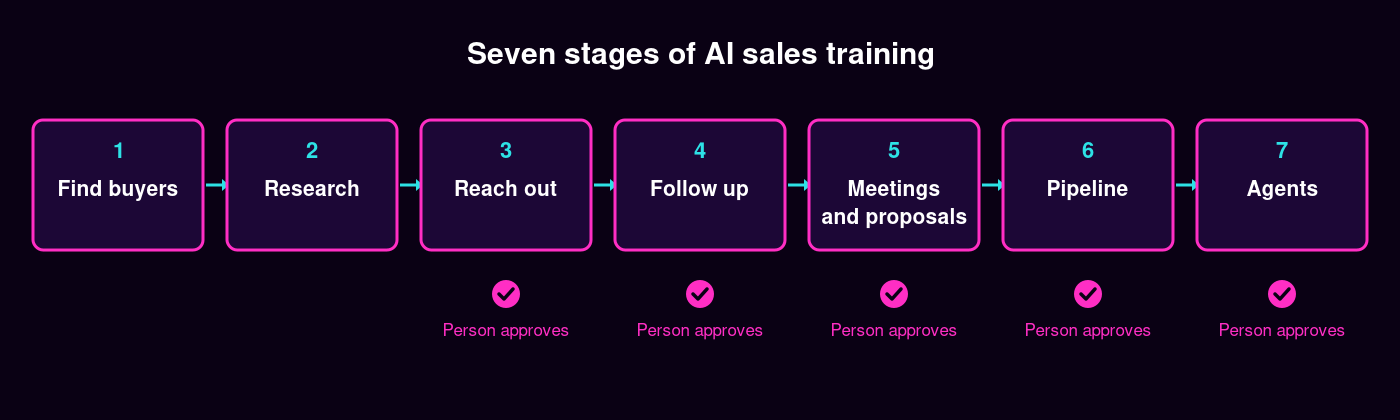
An illustrative example: one account from signal to proposal
The example below is illustrative. It shows how the stages connect for one account. It does not describe a specific client.
- Signal. A target account announces a new head of operations. The signal watch flags the account, and the seller sees that the account has visited the pricing page in the past fortnight.
- Research. The seller asks an AI tool to summarise the account's recent announcements, its annual report and the new executive's public statements. The seller checks each point against its source and removes one claim that the sources do not support.
- Buying group. The seller maps the likely buying group and finds that an existing client used to work with the new executive. The seller asks that client for a warm introduction.
- Outreach. The seller drafts a short first message that refers to the executive's stated priority and offers a relevant case. A manager approves the message, and the seller confirms the business has consent to send it.
- Meeting. Before the meeting, the seller prepares a one-page brief and practises two likely objections in a roleplay. After the meeting, AI drafts the CRM notes and next steps, and the seller corrects them before saving.
- Proposal. The seller drafts a first version of the proposal from a structured brief. The seller and manager agree the commercial terms themselves.
- Follow-up. When the account goes quiet for two weeks, the CRM flags it, and the seller sends a follow-up with a short benchmark the buyer asked about.
At each step, AI did the research, drafting or reminding, and a person checked the facts, approved what went out and made the commercial decisions.
What should stay with a person
Gartner's 2026 survey of 645 business-to-business buyers found that, compared with generative AI, buyers were 39 percentage points more likely to say a sales representative understood their needs. They were also 32 percentage points more likely to say a representative made them feel confident in the purchase decision, and 28 points more likely to say a representative helped them advance to the next step. Gartner describes AI as well suited to account research, personalised messaging, signal monitoring and next best actions, while sellers remain stronger in empathy, judgement, contextual understanding and value framing.
The HBR Analytic Services survey points the same way. Among AI adopters, 55% named critical thinking and judgement as the most important skills for revenue teams to get value from AI, and 49% named knowing when to use, or not use, AI. AI sales training should therefore include practice in checking AI output, not only in producing it. Teams that want to build that skill directly can add critical thinking and human judgement training.
The AI tools a sales team is likely to use
Most AI sales training works with tools the organisation already has. The categories below help a buyer check whether a provider's training fits the team's stack.
| Tool type | What it does in sales | Questions for the training |
|---|---|---|
| General AI assistants (ChatGPT, Claude, Gemini, Microsoft 365 Copilot) | Research, drafting, summarising and analysis | Which version does the organisation license, and what data may go into it? |
| AI features in the CRM | Record updates, summaries, deal risk flags and next best actions | Which features are switched on, and who maintains the data? |
| Call recording and analysis tools | Call notes, coaching insights and patterns across many calls | How will managers use the insights in coaching? |
| Sales engagement and sequencing tools | Scheduled outreach and follow-ups | Where is the approval step, and how are unsubscribes handled? |
| Data and signal tools | Contact data, company data and buying signals | How is consent recorded, and how accurate is the data? |
| AI agents and automation tools | Running a defined workflow when a trigger occurs | What triggers the agent, what may it do, and where does it stop for approval? |
| Roleplay and coaching tools | Practice conversations with an AI buyer | How often will sellers practise, and who reviews the results? |
Training should not require a team to buy new tools before it starts. A team can learn most of the workflows above with a general AI assistant and its existing CRM, then decide which additional tools are worth the cost.
Training formats compared
| Format | What it is | Best for | Limits |
|---|---|---|---|
| AI roleplay software | A platform where sellers practise calls with an AI buyer and get scored | Regular practice on objections and pitches at scale | It covers practice only. It does not change how the team finds buyers, follows up or uses its CRM. |
| Sales methodology training | A provider teaches a selling method, such as a consultative or challenger approach | Teams that need a shared sales method | Many programs now mention AI, but the focus is the method, not AI workflows |
| General AI tool training | Training on ChatGPT, Microsoft 365 Copilot, Claude or Gemini for all staff | A safe baseline across the organisation | Examples are rarely drawn from sales work, so sellers have to translate them |
| In-house AI sales workshop | A workshop for one sales team, built on its own accounts, tools and process | Changing how one team works, with outputs it can use the next week | Needs preparation, a scoping call and real accounts to work on |
| Public AI sales workshop or event | A scheduled session open to people from different organisations | Founders, sales leaders and small teams who want to start before committing a whole team | Less tailored, and participants work on their own businesses separately |
| Longer program | A series of sessions over weeks or months, often across sales, marketing and business development | Organisations that want the change to spread across teams and be measured | Needs a sponsor and an owner inside the organisation |
Many organisations combine formats. A common pattern is a baseline in safe AI use for everyone, an in-house workshop for the sales team on its own process, and regular practice afterwards.
Building on the sales method the team already uses
AI sales training does not need to replace a team's sales method. If a team uses a consultative or question-based approach, AI can help sellers prepare better questions and summarise what they learned. If a team uses a structured qualification framework, AI can check call notes against it and flag missing information. Terrapinn's public account shows a company that simplified its method and rewrote its playbook before retraining, and that order is a sensible default. Training should therefore start by reading the team's playbook, then build AI workflows that support each step of it.
A role-based path
| Role | Focus of AI sales training |
|---|---|
| Sales and business development representatives | Signals, account lists, research, first messages and follow-ups, with an approval step before each send |
| Account executives | Call preparation, objection practice, proposals, business cases and CRM notes |
| Account managers | Expansion and renewal signals, account plans and value reviews for existing clients |
| Sales leaders and managers | Pipeline reviews, coaching from call records, deciding where saved time goes, and the team's rules on AI use |
| Marketing and revenue operations | Content for named accounts, data quality, the tools stack and measurement |
| Partners and senior advisers in professional services firms | Relationship mapping, referrals, pitch preparation and proposals (see the business development section) |
How to prepare for AI sales training
Preparation decides how much of a session is spent on real work. These steps help before any format is booked.
- Pick the accounts. Ask each participant to bring a short list of real target accounts and live opportunities to work on.
- Agree the data rules. Confirm which AI tools are approved, and what customer, prospect and deal information may go into each one.
- Check tool access. Make sure each participant can sign in to the approved AI tools and the CRM before the session.
- Take a baseline. Record the measures in the section below for the weeks before the training.
- Name an owner. Choose a sales leader or revenue operations lead who will own the workflows after the session.
- Share the sales method. Give the provider the team's playbook, sales stages and any approved messaging, so the training builds on them.
- Decide where saved time goes. Agree in advance which high-value activities will get the time the team saves.
The rules that apply to AI-assisted outreach
AI does not change who is responsible for a message. The business that sends or authorises it remains responsible. This section is general information for Australia, not legal advice. Teams selling in other markets should check the rules in each one.
- Consent. Under the Spam Act 2003, a business must have consent before it sends a commercial electronic message, such as a marketing email or text. The Australian Communications and Media Authority (ACMA) describes express consent as best practice and says the sender must be able to prove consent. Buying a list does not transfer that responsibility. (ACMA, Avoid sending spam)
- Identification and unsubscribe. Each commercial message must identify the business that authorised it, include accurate contact details and contain a working unsubscribe option. Unsubscribe requests must be honoured within five working days.
- Automated decisions. From 10 December 2026, organisations covered by the Privacy Act must explain in their privacy policy when a computer program, including generative AI, makes or substantially and directly informs decisions that could significantly affect individuals, and what kinds of personal information it uses. (OAIC, APP 1.7 to 1.9 transparency obligation)
- Company policy. Training should cover what customer data may go into which AI tools, which claims sellers may make, and who approves new uses of AI.
A practical rule for training is that an agent or tool may draft, but a person approves every message that reaches a customer, and consent is checked before anything commercial is sent.
How to measure AI sales training
Measure a small number of things before the training, then again at 30, 60 and 90 days.
- Time spent on selling. Salesforce reports that, globally, the average seller spends 40% of their time selling. Record the current share for the team and check whether it rises.
- Where saved time goes. Gartner's research shows that the gain depends on reinvesting saved time in high-value activities. Agree in advance what the team will do with it, such as more first meetings or better account plans, and track that activity.
- Pipeline from new workflows. Count opportunities created from accounts found through signals or reached through AI-assisted outreach.
- Reply and meeting rates. Compare reply and meeting rates for AI-assisted messages with the team's earlier messages.
- Data quality. Check CRM completeness, such as the share of opportunities with current next steps.
- Workflows still running. At each check, confirm which workflows the team still uses and who owns each one.
Attendance and satisfaction scores show that a session took place. They do not show that the sales process changed.
The first 90 days after the training
The weeks after a session decide whether the new workflows last. A simple plan helps.
- Week 1. Each participant runs at least one new workflow on a live account, such as call preparation or a follow-up, and the owner confirms it is in use.
- Weeks 2 to 4. The team reviews the first results in its weekly sales meeting. It keeps the workflows that work, adjusts the ones that do not and records the approved versions in the playbook.
- Day 30. The owner compares the measures with the baseline and confirms which workflows are still running.
- Days 30 to 60. The team adds one more stage, such as signals or proposals, and managers use call records and roleplays in coaching.
- Day 60. The team decides whether any workflow is ready to run as an agent with an approval step.
- Day 90. The sponsor reviews pipeline created, time spent selling and data quality against the baseline, and decides on the next stage of training or a longer program.
A public example: Terrapinn
Terrapinn, a business-to-business events company, described its experience at aiblLIVE London on 20 October 2026. Its chief operating officer, Sharon Roessen, said the first AI rollout trained about 40 senior leaders and issued 400 Gemini licences, yet 51.5% of users were dormant or very low users. The company then reviewed about 16,000 sales calls, which showed low activity, poor preparation and representatives who pitched instead of selling to value. It simplified its SPIN method, rewrote the sales playbook and began retraining.
The lesson for buyers of AI sales training is that training worked best after the process had been fixed. A course on a new tool would not have changed the habits the call review exposed. A fuller account is in Terrapinn retrained sales after the first AI rollout stalled. (aiblMedia, Terrapinn AI adoption strategy)
Business development in law, accounting and consulting firms
In many professional services firms, partners and senior advisers carry most of the business development work, often without formal sales training. AI can help them in five practical ways.
- Watch for market signals. Track clients and target organisations for events that create a need for advice, such as a transaction, a new regulation, a leadership change or a dispute, so outreach has a reason.
- Follow up consistently. Draft follow-ups after meetings, events and pitches, so promising conversations are not left to memory. A person still approves each message.
- Prepare for pitches. Summarise what is known about the prospective client, prepare questions and draft a first version of the pitch or proposal for the team to edit.
- Build relationships online. Draft useful, specific posts and comments on LinkedIn about issues clients face, and keep track of who engages with them.
- Make referrals easier. Map which clients and contacts are connected to target organisations, and prepare introductions that are easy for a referrer to forward.
Professional services firms also have obligations on confidentiality and conflicts, so the rules on what client information may go into an AI tool should be agreed before any of this starts. Two free Collective Campus guides go further: AI-powered revenue growth for professional services and AI-powered revenue growth for law firms.
Common mistakes in AI sales training
- Starting with tools instead of the sales process. Training that tours many tools leaves sellers unsure which one to use for which stage.
- Training sellers but not managers. If managers do not use the workflows in pipeline reviews and coaching, sellers return to old habits.
- Letting AI send without approval. Automated messages that nobody checks can damage the brand and breach the Spam Act.
- Ignoring data quality. AI summaries and forecasts are only as reliable as the CRM records behind them.
- Measuring only time saved. Gartner's research shows the benefit depends on what the team does with the saved time.
- Skipping practice in checking output. Sellers need to practise spotting claims that the sources do not support, not only writing faster.
- No owner after the session. Without a named owner, new workflows are rarely kept up.
Red flags when choosing a provider
- The session is a demonstration of tools on sample data, with no work on the team's own accounts.
- The provider cannot explain how messages will be approved before they are sent, or how consent and unsubscribe rules are handled.
- The agenda covers many tools but no change to the team's sales process.
- Success is measured only by attendance or a satisfaction survey.
- There is no plan for what happens after the session, such as an owner for each workflow and a check at 30 days.
- The provider promises specific revenue results without a baseline.
Before you book: 12 questions to ask any AI sales training provider
- Will the team work on its own accounts, pipeline and messages during the session?
- Which stages of the team's sales process will the training change, and which will it leave alone?
- What will each person leave with that they can use the following week?
- How will a person approve messages and agent actions before anything reaches a customer?
- How does the training cover the Spam Act, privacy and the organisation's own data rules?
- Which AI tools will be used, and can the training use the tools the team already has?
- How is the training adapted for representatives, account managers and sales leaders?
- How will the team practise checking AI output, not only producing it?
- What should the team measure before the training, and what will be checked at 30, 60 and 90 days?
- Who owns each new workflow after the session?
- How does the training connect with the team's sales method and playbook?
- What happens if a workflow does not work after the session?
How Collective Campus approaches AI sales training
Collective Campus has run capability building programs for teams since 2015 and has worked with teams on AI since 2022. Its AI sales training is built on each team's own accounts, tools and sales process, and a person approves every message before it is sent.
- AI sales training for sales teams: an in-house workshop for one sales team. It covers finding buyers from buying signals, outreach, nurture and conversion, offers that help a prospect say yes, call preparation and proposals, and agents that wait for a person's approval. The workshop is tailored after a scoping call.
- AI Sprint Day: Sales: a public AI sales workshop for founders, sales leaders and sales teams, run in person and online.
- Free AI Sales Plan: enter a website, answer a short set of questions and receive a plan the team can start on.
- AI for Revenue Growth: a longer program for sales, marketing and business development teams.
- Related: the corporate AI training buyer's guide, AI workshops for teams and critical thinking and human judgement training.
Book a call to talk through which format suits your sales team, or start with the free AI Sales Plan to see where AI could help the team first.
Frequently asked questions
What is AI sales training?
AI sales training teaches sales and business development teams to use AI tools across the sales process, from finding buyers and preparing for calls to follow-ups, proposals and CRM updates. Good training uses the team's own accounts and includes an approval step before anything reaches a customer.
How is AI sales training different from sales methodology training?
Sales methodology training teaches a way of selling, such as a consultative approach. AI sales training changes the workflows a team uses to find, research, contact and follow up with buyers. The two work best together, with AI workflows built around the team's chosen method.
Is AI roleplay software enough?
Roleplay software is useful for regular practice on calls and objections. It does not change how a team finds buyers, writes outreach or keeps its pipeline up to date, so most teams pair it with training on those workflows.
Will AI send messages to customers on its own?
It should not. A sound setup lets AI and agents draft messages and actions, and a person approves each one before it is sent.
Is AI-written sales outreach legal in Australia?
The same rules apply whether a person or an AI tool writes the message. Under the Spam Act 2003, commercial electronic messages need consent, must identify the sender and must include a working unsubscribe option. This is general information, not legal advice.
Do sellers need technical skills?
No. AI sales training is usually built for non-technical sellers using tools such as ChatGPT, Claude, Gemini or Microsoft 365 Copilot alongside their CRM.
How do you measure the results of AI sales training?
Take a baseline first, then check at 30, 60 and 90 days: the share of time spent selling, what the team did with saved time, pipeline created from new workflows, reply and meeting rates, CRM data quality and which workflows are still running.
Who should attend AI sales training?
The people who sell and the people who manage them: business development representatives, account executives, account managers and sales leaders. Marketing and revenue operations staff often join when the workflows depend on their content or data.
How long does AI sales training take?
Formats range from a half-day workshop to a program over several months. A short workshop suits a team that wants to change one or two stages of its process. A longer program suits an organisation that wants the change to reach sales, marketing and business development and to be measured over a quarter.
Can AI sales training work for professional services firms?
Yes, as long as it is built around how partners and advisers win work, such as referrals, pitches and relationships, and covers the firm's rules on confidentiality and conflicts.