
How Local Australian Sports Clubs Can Find and Contact Hundreds of Sponsors with AI

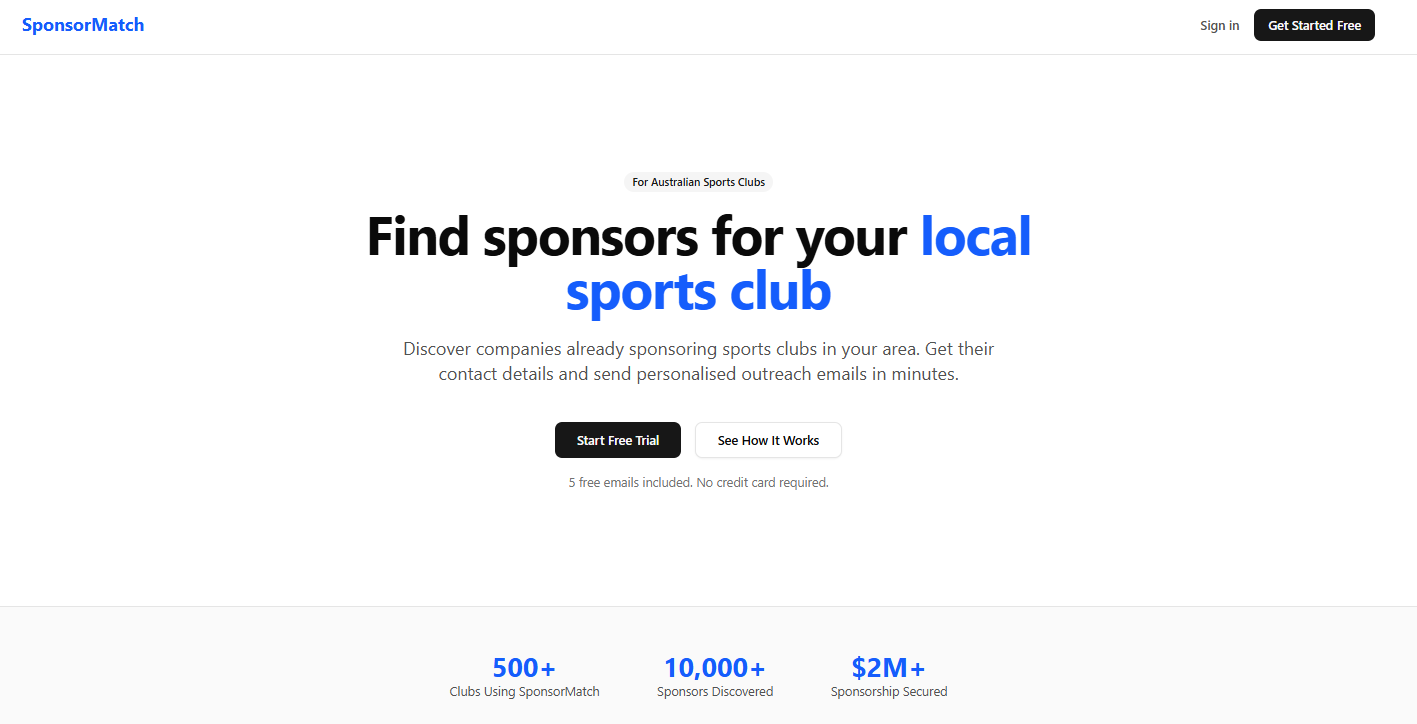
Try SponsorMatch for free here, and start reaching out to sponsors of community sports organizations in your area today.
Every weekend, across thousands of towns and cities, a quiet miracle happens. Parents bundle children into cars at ungodly hours. Volunteers arrive early to set up equipment, mark pitches, and prepare facilities. Coaches who've spent their week in offices, warehouses, and classrooms transform into mentors, strategists, and occasional referees. And somewhere, in a clubhouse that's seen better days, a treasurer stares at a spreadsheet, wondering how they're going to make the numbers work for another season.
This is the reality of grassroots sport. It's the foundation upon which elite athletics is built, the crucible where future professionals first learn to love the game, and—perhaps more importantly—the social glue that holds communities together. Local sports clubs don't just produce athletes; they produce citizens. They give young people structure, teach them about teamwork and resilience, and provide a sense of belonging that's increasingly rare in our fragmented digital age.
But there's a problem. A big one. And it's threatening the very existence of these community institutions.
Money.
Specifically, the lack of it. And even more specifically, the challenge of finding sponsors willing to support local clubs in an era when marketing budgets are scrutinised more carefully than ever and businesses face their own economic pressures.
This article explores the sponsorship crisis facing local sports clubs, examines why traditional approaches to finding sponsors are failing, and introduces a new tool that's changing how clubs connect with potential backers. Whether you're a club secretary desperate for funding, a volunteer trying to keep your organisation afloat, or simply someone who cares about the future of community sport, this is a story you need to understand.
Let's start with some uncomfortable truths. According to research from various sporting bodies, the average local sports club operates on a budget that would make most small businesses wince. Annual revenues typically range from a few thousand to perhaps fifty thousand pounds or dollars, depending on the sport, location, and club size. Within these modest budgets, sponsorship income represents a crucial—and often unpredictable—portion.
The challenge is stark: while elite sport attracts billions in sponsorship globally, the vast majority of that money flows to professional teams and major events. The local rugby club, the community swimming squad, the youth football team—these organisations are fighting for scraps from a table groaning with food they'll never taste.
Consider what sponsorship means to a typical local club. A few hundred pounds might cover new equipment. A thousand could fund coaching qualifications. Several thousand might mean the difference between surviving another year and folding entirely. These aren't abstract figures; they represent real opportunities for real people in real communities.
The importance of sponsorship has grown as other funding sources have become less reliable. Government grants are increasingly competitive and often tied to specific outcomes that don't match every club's circumstances. Membership fees can only rise so much before they become barriers to participation—the very opposite of what community sport should be about. Fundraising events require volunteer time that's already stretched thin.
Sponsorship offers something different: a partnership that can benefit both parties. For businesses, it's an opportunity to embed themselves in their community, to associate their brand with positive values, and to reach an engaged local audience. For clubs, it's funding that doesn't require endless grant applications or exhausting fundraising marathons.
The theory is elegant. The practice is considerably messier.
Understanding why sponsorship has become harder requires understanding how local business has changed. Thirty years ago, the high street was dominated by independent retailers, family-owned businesses with deep roots in their communities. The local builder, the town solicitor, the family butcher—these were people who saw their communities as stakeholders, not just customers.
Today's landscape is different. Chain stores have replaced independents. Online commerce has hollowed out high streets. Many businesses with a physical presence in a community are actually owned by distant corporations with centralised marketing budgets and no particular interest in local partnerships. The potential sponsor pool has shrunk even as the need for sponsorship has grown.
This doesn't mean sponsors don't exist—they absolutely do. But finding them requires more effort, more creativity, and more persistence than ever before.
Walk into almost any local sports club and ask how they find sponsors, and you'll hear variations on the same themes.
Personal networks form the backbone of most sponsorship efforts. The club chair knows someone who runs a plumbing business. The coach's brother-in-law owns a car dealership. A parent works in marketing at a regional company. These personal connections are valuable, but they're limited by who happens to be involved with the club at any given time.
Geographic proximity is another common approach. Clubs identify businesses near their facilities—the pub down the road, the industrial estate around the corner, the retail park across town—and make speculative approaches. It's logical, but it's also hit-or-miss, dependent on whether those particular businesses have any interest in sponsorship.
Word of mouth spreads information about which businesses have sponsored similar organisations. If the cricket club got funding from a local solicitors' firm, perhaps the football club should try the same approach. This informal intelligence network can be useful, but it's also incomplete and often outdated.
Generic outreach rounds out the typical approach. Clubs send letters or emails to businesses they've found in directories, on Google Maps, or through other general sources. Response rates are typically abysmal—often well under 5%.
At the heart of these challenges lies a fundamental problem that economists would recognise: information asymmetry. Clubs don't know which businesses are likely to be interested in sponsorship, and businesses don't know which clubs are seeking sponsors. Both sides are operating with incomplete information, leading to massive inefficiencies.
Consider the process from a club's perspective. You need sponsors. But which businesses should you approach? You could try everyone, but that's impractical—there might be thousands of businesses in your area. So you make educated guesses, approach a few dozen, and hope for the best. Most of your efforts go nowhere.
Now consider it from a business perspective. You might be perfectly happy to sponsor a local sports club—it's good for the community, good for your image, and the costs are modest. But how would clubs know to approach you? Unless you actively advertise your interest (which almost no business does), you're invisible to the very organisations you might want to support.
This information gap is the central challenge of local sports sponsorship. And while it's always existed, changes in technology, business practices, and community structures have made it worse, not better.
Even if you could identify every potential sponsor in your area, you'd face another challenge: time. Finding sponsors is labour-intensive work, and local clubs are typically run by volunteers who already have demanding commitments.
Let's break down what's actually involved in a traditional sponsorship search:
Research phase: You need to identify potential sponsors. This means trawling through business directories, local news archives, social media, and other sources to compile a list of possibilities. For a thorough search, this might take dozens of hours.
Qualification phase: Not every business is a realistic prospect. You need to assess factors like company size, apparent community involvement, and likely fit with your club. This adds more hours to your workload.
Contact finding phase: Once you've identified promising prospects, you need to find the right person to contact. For a small business, this might be straightforward. For a larger company, you might need to navigate complex organisational structures to find whoever handles community partnerships or local marketing.
Outreach phase: Now you actually approach potential sponsors. This means crafting compelling communications, following up (multiple times, usually), and managing responses—or more often, the lack of responses.
Negotiation and administration: If you're fortunate enough to get positive responses, you need to negotiate terms, prepare agreements, and manage the ongoing relationship.
For a volunteer squeezing this work between their job, family commitments, and actually participating in the sport they love, this process is exhausting. It's no wonder that many clubs either give up on sponsorship entirely or settle for whatever opportunities fall into their laps through personal connections.
Here's an insight that's obvious once you see it but that many clubs miss: businesses that have already sponsored sports clubs are far more likely to sponsor others than businesses that haven't.
Think about why this makes sense. A business that has sponsored a local football club has already:
Compare this to a business that has never sponsored a sports club. That business might be perfectly willing to become a sponsor, but there's no evidence either way. You're starting from scratch, trying to convince them that sponsorship is a good idea before you can even begin discussing your specific club.
This insight—that prior sponsorship behaviour is a powerful predictor of future sponsorship interest—should reshape how clubs approach their search. Instead of casting a wide net and hoping for the best, clubs should prioritise businesses with a demonstrated track record of supporting community sport.
But here's the catch: how do you find these businesses?
The most obvious source is observation. You can look at the shirts of other local teams, the advertising boards at other clubs' grounds, the programmes distributed at community events. Every sponsor logo you spot is a potential lead.
This approach works, but it's incredibly time-consuming. It requires physically visiting multiple sports clubs, attending their events, and systematically recording what you see. For a volunteer already stretched thin, this kind of comprehensive survey is often impractical.
You could also rely on informal networks—asking friends at other clubs who their sponsors are, sharing information through local sports councils or league meetings. This is better than nothing, but it's patchy. You might learn about some sponsors through these channels, but you'll miss many others.
Digital research offers another avenue. Some clubs list their sponsors on websites. Some sponsors mention their community involvement on their own sites or social media. But gathering this information requires hours of searching, and much of it is incomplete or outdated.
The frustrating reality is that the information exists—businesses are sponsoring local sports clubs all over your area—but it's scattered, fragmented, and difficult to aggregate. Clubs are left piecing together incomplete pictures from multiple sources, never quite sure if they've found all the possibilities.
The human cost of inefficient sponsorship processes is real. Volunteers who take on sponsorship responsibilities often find themselves overwhelmed by the sheer amount of work involved. What starts as a willingness to help the club can become a crushing burden, leading to burnout, resignation, and—ultimately—clubs losing experienced volunteers they can't afford to lose.
This isn't abstract. Talk to anyone who's served on the committee of a local sports club, and you'll hear stories of sponsorship coordinators who threw in the towel after months of fruitless outreach, of treasurers who dreaded the annual sponsorship renewal process, of well-intentioned volunteers who simply didn't have the hours needed to do the job properly.
The volunteer time consumed by inefficient sponsorship processes is time not spent on other vital activities: coaching young players, maintaining facilities, planning events, and actually participating in the sport. The opportunity cost is enormous.
Inefficient processes don't just waste time; they leave money on the table. When clubs can only approach a fraction of potential sponsors, they inevitably miss opportunities that could have materialised with better information.
Imagine a local business that would be delighted to sponsor your club but never gets approached because no one knew they were interested. That business might sponsor a competitor instead, or simply keep the money in their marketing budget. Either way, your club loses out through no fault of its own—simply because the information gap was never bridged.
These missed opportunities compound over time. A sponsorship relationship that never starts can't grow. A business that never connects with your club can't become a long-term partner. The cumulative effect of years of inefficiency is substantial, even if it's invisible in any single year's accounts.
The current system also creates inequities between clubs. Organisations with well-connected members—those with extensive business networks, professional marketing experience, or simply more time to devote to sponsorship searches—consistently outperform clubs without these advantages.
This means that sponsorship success often correlates with socioeconomic factors that have nothing to do with a club's value to its community. A club in an affluent area with professional-class members might secure sponsors easily through personal networks, while a club in a disadvantaged area—potentially serving young people who would benefit most from sporting opportunities—struggles despite equal or greater community impact.
This isn't how community sport should work. Funding shouldn't flow to clubs based on their members' business connections; it should flow to clubs based on their community contribution. But as long as sponsorship depends on inefficient, network-dependent processes, these inequities will persist.
Let's return to the insight mentioned earlier: businesses that have sponsored local sports clubs in the past are dramatically more likely to sponsor them in the future. This isn't just intuition; it's a principle that makes sense from multiple perspectives.
Psychological commitment: A business that has sponsored community sport has crossed a psychological threshold. They've moved from "we might consider this someday" to "we actively do this." That shift matters enormously. Future sponsorship decisions start from a position of commitment rather than scepticism.
Operational infrastructure: Sponsoring a sports club, even at modest levels, requires administrative capacity. Someone needs to authorise payments, review agreements, and manage the relationship. A business that has done this before has established processes. A business that hasn't would need to create them from scratch—a friction point that often kills otherwise promising opportunities.
Budget allocation: Sponsorship money has to come from somewhere. Businesses that have sponsored sports clubs typically have budget lines—formal or informal—for this purpose. They've already answered the question "Can we afford this?" with a "Yes." New sponsors face that question for the first time, with uncertain answers.
Demonstrated values: Perhaps most importantly, prior sponsorship signals that a business values community sport. They've shown their hand. You're not guessing about their priorities; you're seeing them in action.
While comprehensive statistics on local sports sponsorship are hard to come by, available evidence supports this insight powerfully. Studies of charitable giving—a related but not identical domain—consistently show that past giving is the strongest predictor of future giving. Businesses that support one community cause tend to support others.
Anecdotally, ask any experienced club administrator about their sponsorship patterns, and they'll confirm the principle. Renewals from existing sponsors are far easier to secure than new partnerships. And new sponsors are far more likely to say yes if they've sponsored similar organisations before.
This suggests a strategic reorientation for clubs seeking sponsors. Instead of treating all businesses as equally likely prospects, clubs should prioritise those with demonstrated interest in community sports sponsorship. The conversion rate on these approaches will be dramatically higher than generic outreach to businesses with no track record of support.
Understanding that prior sponsors are better prospects doesn't solve the practical problem of finding them. If anything, it sharpens the challenge: you now know what you're looking for, but you still don't know how to find it efficiently.
This is where the status quo breaks down most painfully. The insight that prior sponsors are valuable prospects is actionable only if you can identify those sponsors without investing prohibitive time. Otherwise, you're stuck with the same inefficient processes, just with better theoretical justification for what you're trying to achieve.
What clubs need is a way to bridge the information gap—to quickly and efficiently identify businesses in their area that have shown willingness to sponsor local sports clubs. This would transform sponsorship from a game of blind outreach to a targeted, high-probability activity.
Technology has transformed countless aspects of how organisations operate. Customer relationship management, financial administration, communication, volunteer coordination—all have been revolutionised by software tools that automate tedious tasks and enable activities that would otherwise be impractical.
Sponsorship, though, has been left behind. The tools available to clubs seeking sponsors are essentially the same ones that have existed for decades: email clients, spreadsheets, and general-purpose databases. There's no equivalent to the sophisticated platforms that have transformed other fundraising domains.
Consider charitable giving, where platforms like JustGiving or GoFundMe have created entirely new ways for organisations to connect with donors. Or consider crowdfunding, where sites like Kickstarter enable projects to find supporters across the globe. These tools work because they solve the information problem—they make it easy for those seeking funding to connect with those willing to provide it.
Local sports sponsorship has nothing comparable. Clubs are still operating in an essentially analogue world, manually searching for prospects, individually reaching out to each one, and tracking everything in spreadsheets that grow increasingly unwieldy over time.
Imagine, for a moment, what an ideal sponsorship tool would do.
It would start by aggregating information about sponsors in your area. Instead of manually discovering that the local building firm sponsors the cricket club and the dental practice sponsors the rugby team, you'd have this information readily available. The tool would have already done the research, compiled the data, and made it searchable.
It would let you identify businesses that have sponsored sports clubs similar to yours—same sport, same level, same general area. These are your highest-probability prospects, the businesses most likely to say yes to your approach.
It would provide contact information, saving you the hours typically spent tracking down the right person at each business. No more searching LinkedIn profiles, calling reception desks, or sending emails into corporate voids.
It would enable efficient outreach at scale. Instead of manually composing and sending individual approaches, you could reach dozens or hundreds of prospects with appropriate, personalised communications.
It would track your efforts, helping you manage follow-ups, monitor responses, and maintain relationships over time.
In short, it would transform sponsorship from a manual, inefficient, time-consuming process into a systematic, scalable activity that even time-pressed volunteers could manage effectively.
For years, this tool didn't exist. Clubs knew what they needed but couldn't find anything that provided it. The sponsorship search remained stubbornly manual, stubbornly inefficient, and stubbornly frustrating.
That's now changed.
SponsorMatch is a tool designed specifically to address the challenges outlined in this article. It enables local sports clubs to identify, research, and contact potential sponsors efficiently—turning what was once a months-long manual process into something that can be accomplished in hours.
The premise is simple but powerful: businesses that have already sponsored local sports clubs are far more likely to sponsor yours than businesses that haven't. SponsorMatch makes it easy to find these businesses, understand their sponsorship patterns, and reach out to them directly.
At its core, SponsorMatch is an intelligent database of sponsorship relationships. It aggregates information about which businesses are sponsoring which sports clubs in your area, creating a comprehensive picture of the local sponsorship landscape that would take individual clubs months to compile manually.
When you use SponsorMatch, you can search for sponsors based on multiple criteria:
Geographic area: Find businesses sponsoring sports clubs within a certain radius of your location. This ensures you're targeting prospects who are genuinely local and likely to have interest in your community.
Sport type: Filter for businesses that have shown interest in your particular sport. A business that sponsors football clubs might or might not be interested in cricket; knowing their preferences helps you prioritise your outreach.
Sponsorship level: Some businesses provide major funding; others contribute more modestly. Understanding typical sponsorship levels helps you calibrate your requests appropriately.
Industry sector: Certain industries are more active in sports sponsorship than others. SponsorMatch lets you identify which sectors are most engaged in your area, helping you focus your efforts.
Finding potential sponsors is only the first step; you also need to reach them. SponsorMatch addresses this by providing contact information for the businesses in its database. Instead of spending hours hunting for email addresses and phone numbers, you can move directly from identification to outreach.
The platform also facilitates the outreach itself. Rather than sending individual emails to each prospect—a process that becomes unmanageable at any real scale—you can communicate with hundreds or thousands of potential sponsors directly through the app. This doesn't mean sending spam; it means efficient, appropriate communication with businesses that have already demonstrated interest in sports sponsorship.
Perhaps the most significant benefit of SponsorMatch is the scale it enables. A volunteer using traditional methods might approach a few dozen potential sponsors over several months. With SponsorMatch, that same volunteer can identify and reach thousands of prospects in a fraction of the time.
This scale advantage matters in multiple ways. Most obviously, it increases the absolute number of positive responses you're likely to receive. Even if your conversion rate stays the same, reaching more prospects means securing more sponsors.
But scale also changes the conversion rate itself. By enabling you to focus on pre-qualified prospects—businesses with demonstrated interest in sports sponsorship—SponsorMatch helps you avoid the wasted effort of approaching businesses that were never going to say yes. Your hit rate goes up even as your reach expands.
SponsorMatch was designed with actual club needs in mind. It recognises that the people seeking sponsors are typically volunteers, not professional fundraisers. It doesn't assume extensive technical expertise or unlimited time. It aims to be simple enough that a club secretary can use it effectively while powerful enough to transform their results.
This practical orientation shows in the platform's design. The interface is straightforward, the workflow is logical, and the focus is relentlessly on outcomes—helping clubs find sponsors—rather than impressive-sounding features that don't contribute to that goal.
With a tool like SponsorMatch available, clubs can fundamentally rethink how they approach sponsorship. Instead of ad hoc efforts based on personal networks and speculative outreach, you can adopt a systematic strategy that maximises your chances of success.
Here's a framework for doing this:
Step One: Map the Landscape
Before reaching out to anyone, understand your local sponsorship ecosystem. Who is currently sponsoring sports clubs in your area? What industries are most active? What sponsorship levels are typical? SponsorMatch makes this mapping exercise quick and comprehensive, giving you intelligence that would otherwise take months to gather.
Step Two: Identify Your Best Prospects
Using the insights from your landscape mapping, identify the businesses most likely to sponsor your club. Prioritise those that have sponsored similar organisations—same sport, same level, same area. These are your warm prospects, the businesses most likely to convert.
Step Three: Prepare Your Proposition
Before reaching out, ensure you have a compelling sponsorship proposition. What will sponsors receive? Brand visibility? Community association? Specific promotional opportunities? Your proposition should be clear, concrete, and tailored to the likely interests of local businesses.
Step Four: Execute Targeted Outreach
With your prospect list prepared and your proposition polished, begin your outreach. SponsorMatch enables you to contact prospects at scale while still maintaining appropriate personalisation. Be professional, be concise, and be clear about what you're offering and what you're asking.
Step Five: Follow Up Systematically
Initial outreach rarely produces immediate results. Most sponsorships emerge from persistent, professional follow-up. Use SponsorMatch to track your communications and ensure no promising conversation falls through the cracks.
Step Six: Nurture Relationships
When you secure sponsors, focus on making the relationship a success. Deliver on your promises, keep sponsors informed about club activities, and make them feel valued. A happy sponsor is likely to renew and might well increase their commitment over time.
Access to better tools doesn't eliminate the need for professional conduct. If anything, the ability to reach more prospects makes professionalism more important. A single poorly judged communication can damage your club's reputation; multiply that by hundreds of contacts, and the stakes are significant.
This means your outreach should be polished, your propositions should be realistic, and your follow-up should be courteous. Businesses that sponsor local sport expect to deal with well-organised partners, not chaotic amateurs. First impressions matter, and SponsorMatch gives you the opportunity to make many first impressions.
SponsorMatch doesn't replace personal networks; it complements them. Your existing connections remain valuable. What changes is your ability to reach beyond those connections efficiently, expanding your prospect universe while maintaining the quality of your approach.
The ideal strategy uses both. Leverage personal relationships where they exist—they'll always convert at higher rates than cold outreach. But don't limit yourself to those relationships. Use SponsorMatch to identify prospects outside your immediate network, and approach them with the same professionalism you'd bring to any business relationship.
When clubs adopt efficient sponsorship processes, the results can be transformative. Consider some scenarios that become possible:
The resource-constrained club that has struggled for years with inadequate equipment and facilities can secure the funding needed for meaningful improvements. Better equipment attracts better players, raising standards and increasing participation.
The ambitious club that wants to expand its programmes—adding teams, serving new age groups, offering coaching pathways—can secure the sponsorship to make these aspirations reality. Growth that seemed impossible becomes achievable.
The community-focused club that wants to offer subsidised or free participation for disadvantaged young people can find sponsors who share these values and will fund accessibility initiatives.
The volunteer-dependent club can reduce the burden on its hardest-working members. When sponsorship can be secured efficiently, volunteers can redirect their energy to other vital activities.
The benefits extend beyond individual clubs. When local sports organisations thrive, communities benefit. Young people have positive activities. Adults have social connections. Facilities are maintained and improved. The social fabric that holds communities together is strengthened.
Businesses benefit too. Those that sponsor local sport embed themselves in their communities, building relationships and reputation that marketing campaigns can't buy. Local sponsorship creates genuine connection in an era when brands are often perceived as distant and impersonal.
And the sport itself benefits. The pathway from grassroots to elite depends on thriving local clubs. Every professional athlete started somewhere—usually at a community organisation run by volunteers, funded by modest sponsorships, and sustained by love of the game. Strengthening this foundation strengthens everything built upon it.
If you're involved with a local sports club and ready to take a more systematic approach to sponsorship, here's how to begin:
Visit SponsorMatch and explore the platform. Familiarise yourself with its capabilities and understand how it can support your sponsorship efforts.
Audit your current situation: Before diving into outreach, understand where you stand. How much sponsorship income do you currently receive? Who are your existing sponsors? What relationships are working well, and which need attention?
Define your goals: What would success look like? More sponsors? Higher total funding? Longer-term commitments? Sponsors from specific industries? Clear goals will guide your strategy and help you measure progress.
Develop your proposition: Create compelling sponsorship packages that offer genuine value to businesses. Consider different tiers to accommodate various budgets, and be specific about what sponsors will receive.
Begin your outreach: Using SponsorMatch, identify your best prospects and start reaching out. Be patient—sponsorship is a long-term game—but be persistent. Consistent, professional effort will yield results over time.
Track and improve: Monitor your results. Which approaches are working? Which prospects are responding? Use this intelligence to refine your strategy continuously.
The goal isn't just to secure sponsors this year; it's to build sustainable practices that will support your club for years to come. This means:
Documenting processes so that knowledge isn't lost when volunteers move on
Creating templates for proposals, communications, and agreements
Building a database of sponsor relationships, contact histories, and outcomes
Training multiple people in sponsorship activities so the burden doesn't fall on any single volunteer
Reviewing annually what's working and what needs adjustment
With SponsorMatch as a foundation and strong internal practices as a framework, your club can establish a sponsorship function that runs efficiently year after year.
The challenges facing local sports sponsorship aren't going away. Business structures will continue to evolve. Volunteer time will remain precious. Competition for sponsor attention will intensify.
But the tools available to address these challenges are improving. SponsorMatch represents a new category of solution—purpose-built technology that addresses the specific problems of local sports clubs. As these tools mature and adoption grows, the entire sponsorship ecosystem will become more efficient.
Imagine a future where every local club has ready access to comprehensive sponsor intelligence. Where outreach is targeted, professional, and effective. Where the information asymmetry that has plagued sponsorship for decades is finally resolved. That future is closer than you might think.
Technology alone won't save local sport. The human elements—passionate volunteers, dedicated coaches, supportive communities—will always be essential. But technology can remove barriers, eliminate inefficiencies, and enable the humans involved to focus their energy where it matters most.
This is what SponsorMatch aims to do. Not to replace the hard work of building sponsor relationships, but to make that work more effective. Not to automate the human connection at the heart of local sport, but to facilitate connections that would otherwise never happen.
If you've read this far, you probably care about the future of community sport. Perhaps you're a club volunteer frustrated by sponsorship challenges. Perhaps you're a business owner who wants to support local organisations but doesn't know how to connect with them. Perhaps you're simply someone who believes in the value of grassroots athletics and wants to see it thrive.
Whatever your role, there's something you can do:
Club volunteers: Explore SponsorMatch. Share it with your committees. Advocate for systematic, efficient approaches to sponsorship that can transform your organisation's financial health.
Business owners: Consider sponsoring local sports clubs. The investment is modest; the impact is significant. Tools like SponsorMatch make it easier than ever for clubs to find you and propose meaningful partnerships.
Community members: Support your local clubs. Attend events, volunteer if you can, and encourage businesses you patronise to consider local sponsorship.
Everyone: Spread the word. The more people who understand both the challenges facing local sport and the solutions now available, the better the prospects for our sporting communities.
Local sports clubs face real challenges. Funding is tight, volunteers are stretched, and traditional approaches to sponsorship have become increasingly inadequate. The gap between the funding clubs need and the funding they can readily access threatens the future of community sport.
But this challenge is not insurmountable. By understanding the dynamics of local sponsorship—particularly the predictive power of prior sponsorship behaviour—clubs can focus their efforts more effectively. And by leveraging tools like SponsorMatch, they can execute those focused efforts at a scale that was previously impossible.
The clubs that thrive in the coming years will be those that combine genuine community value with professional approaches to sustaining themselves financially. They'll understand that sponsorship is a partnership, offering benefits to businesses as well as receiving them. They'll use available tools to work efficiently, respecting the limited time of their volunteers. And they'll build sustainable practices that don't depend on any single person's connections or efforts.
This is achievable. The tools exist. The sponsors exist. The need is clear, and the path forward is visible.
What remains is action. The local sports club that takes systematic control of its sponsorship future—mapping its landscape, identifying its best prospects, crafting compelling propositions, and executing professional outreach at scale—will be the club that flourishes. The club that continues with ad hoc, inefficient approaches will struggle.
The choice is in your hands.
For the sake of the young people who need these clubs, for the sake of the communities that depend on them, and for the sake of the sports we all love: it's time to embrace a better way. Visit SponsorMatch, explore what's possible, and start building the future your club deserves.
This article was written to support local sports clubs in their vital work. If you found it useful, please share it with others who might benefit. And if you're ready to transform your club's approach to sponsorship, SponsorMatch is ready to help.
.png)
The WorkFlow podcast is hosted by Steve Glaveski with a mission to help you unlock your potential to do more great work in far less time, whether you're working as part of a team or flying solo, and to set you up for a richer life.


To help you avoid stepping into these all too common pitfalls, we’ve reflected on our five years as an organization working on corporate innovation programs across the globe, and have prepared 100 DOs and DON’Ts.


